As war-driven fuel shocks rattle global markets, Beijing is treating solar, grids, storage, hydropower, nuclear and EVs less as green symbolism than as strategic insulation.
On April 6, 2026, as the Iran war and the Strait of Hormuz crisis were still convulsing energy markets, Xi Jinping urged faster planning and construction of a “new energy system.” The signal mattered less because it was dramatic than because it was revealing. Xi paired continued low-carbon development with support for hydropower, orderly nuclear expansion and coal’s ongoing stabilizing role. That is not the language of a government treating climate policy as a side project. It is the language of a state trying to redesign its energy base so that external shocks have less power over domestic growth.
The timing sharpened the point. On April 7, IEA chief Fatih Birol said the current oil and gas shock tied to the Hormuz blockade was more serious than the crises of 1973, 1979 and 2022 combined. About one-fifth of the world’s oil and gas typically moves through that narrow waterway. A fragile April 8 ceasefire briefly eased pressure and pushed Brent down sharply, but the structural lesson did not change: an economy that still leans heavily on traded hydrocarbons remains vulnerable to geopolitics it cannot control.
China is not immune to that vulnerability, but it is better cushioned than many peers. Reuters reported on April 7 that Beijing once again capped domestic fuel-price increases at roughly half the usual formula-driven rise, softening the immediate blow to consumers. Analysts cited by Reuters said China has weathered the shock better than many Asian importers because of its diversified supply network, large oil stockpiles and rapid EV adoption. Imports via Hormuz account for only around 5% of China’s total energy consumption. That figure does not mean China is safe. It means Beijing has already spent years trying to reduce how exposed it is.
From clean buildout to strategic architecture
The scale of that effort is now too large to describe as a conventional green transition. The IEA says China’s clean-energy investment topped $625 billion in 2024, nearly double the level of 2015. Official data released in February showed that China added more than 430 gigawatts of new wind and solar capacity in 2025 alone, taking cumulative grid-connected wind and solar capacity to 1.84 terawatts, or 47.3% of total installed power capacity. Wind and solar also supplied 22% of the country’s electricity output in 2025. By one Reuters analysis citing Global Energy Monitor, China ended 2025 with 1,494 GW of clean power capacity in operation, above the 1,420 GW running on fossil fuels.
Those numbers sit on top of an already extraordinary base. In 2024, China added more than 340 GW of solar and 80 GW of wind, according to the IEA, and surpassed its 2030 target of 1,200 GW of combined wind and solar capacity six years early. That pace is often framed as evidence of Beijing’s climate ambition. It is that. But it is also something more practical: a systematic attempt to shift a larger share of the country’s energy future toward domestically controlled electricity rather than imported fuel.
Demand is what makes that shift strategically urgent. The IEA estimates that China’s electricity consumption rose by more than 550 terawatt-hours, or 7%, in 2024 alone, almost as much as the average annual increase in global electricity consumption over the previous decade. In a country where industrial demand, cooling load, EV charging and digital infrastructure are all expanding at once, energy security is no longer just a question of supply. It is a question of whether the power system itself can scale fast enough, and intelligently enough, to carry the economy.
The real bottleneck is no longer generation
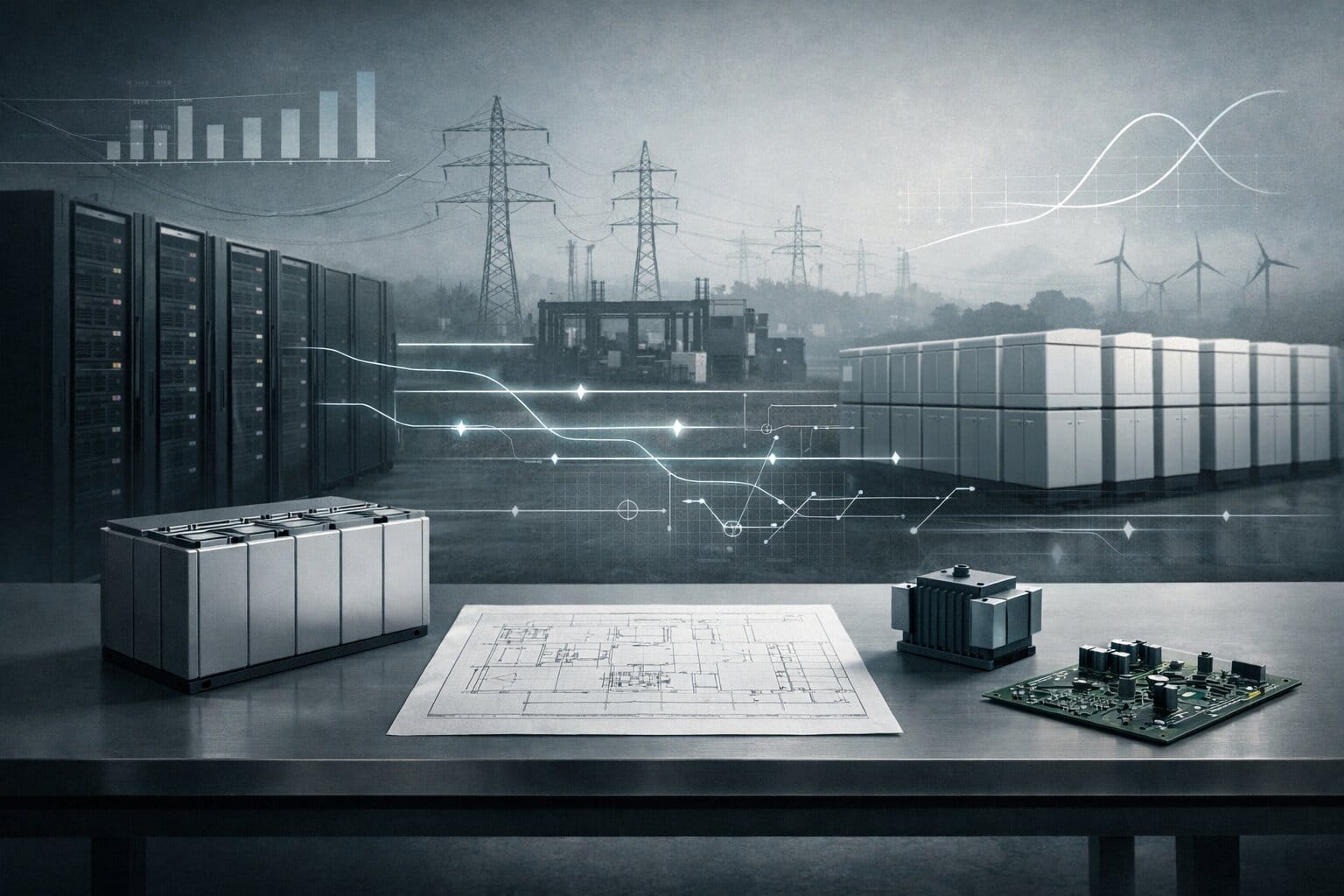
That is where the phrase “new energy system” becomes concrete. The IEA argues that China’s energy priorities have shifted from simply building more capacity to making sure that capacity is reliable, usable and economically productive. In 2025, China was set to spend about $88 billion on transmission and distribution. The reason is straightforward: heatwaves and industrial demand spikes have exposed weaknesses in the grid, while renewable deployment has in some places outpaced the infrastructure needed to move and balance the electricity. China’s challenge is no longer whether it can build solar panels and wind farms at scale. It is whether it can absorb them without wasting their output or destabilizing the system.
Beijing’s answer is to treat the grid as strategic infrastructure. Reuters reported in January that State Grid plans to spend 4 trillion yuan, roughly $574 billion, between 2026 and 2030 on upgrades, a 40% jump from the previous five-year period. Government guidance published at the end of 2025 called for a west-to-east transmission system exceeding 420 GW by 2030, with added interprovincial balancing capacity to help absorb more renewable generation. The logic is unmistakable: the strategic asset is no longer just the solar base in the west or the offshore wind cluster on the coast. It is the national system that can turn variable power into dependable supply for factories, cities and digital infrastructure.
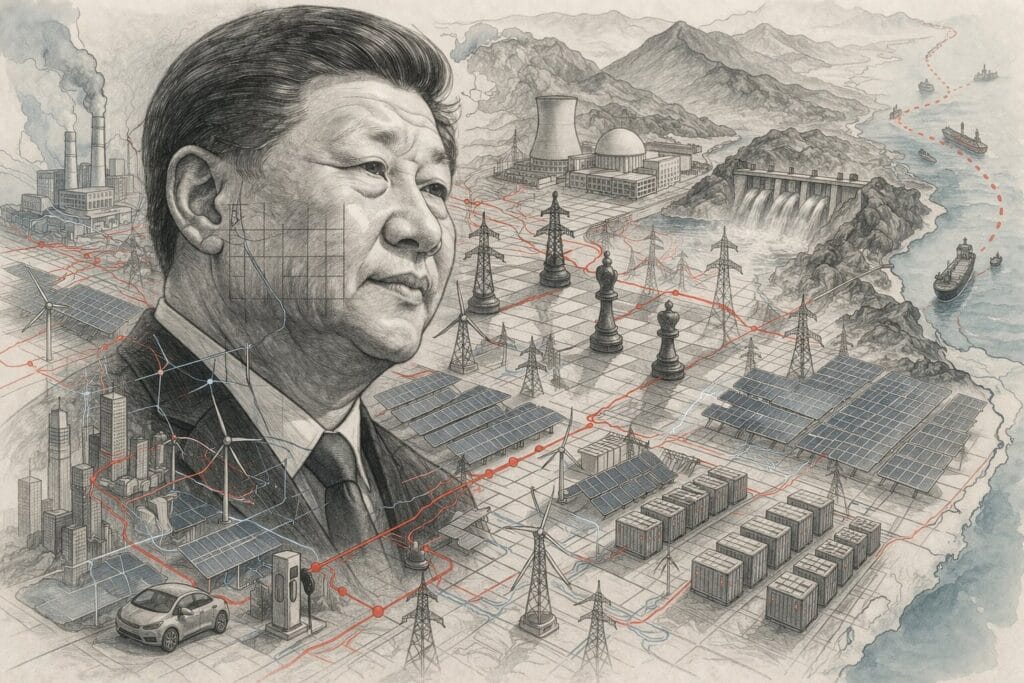
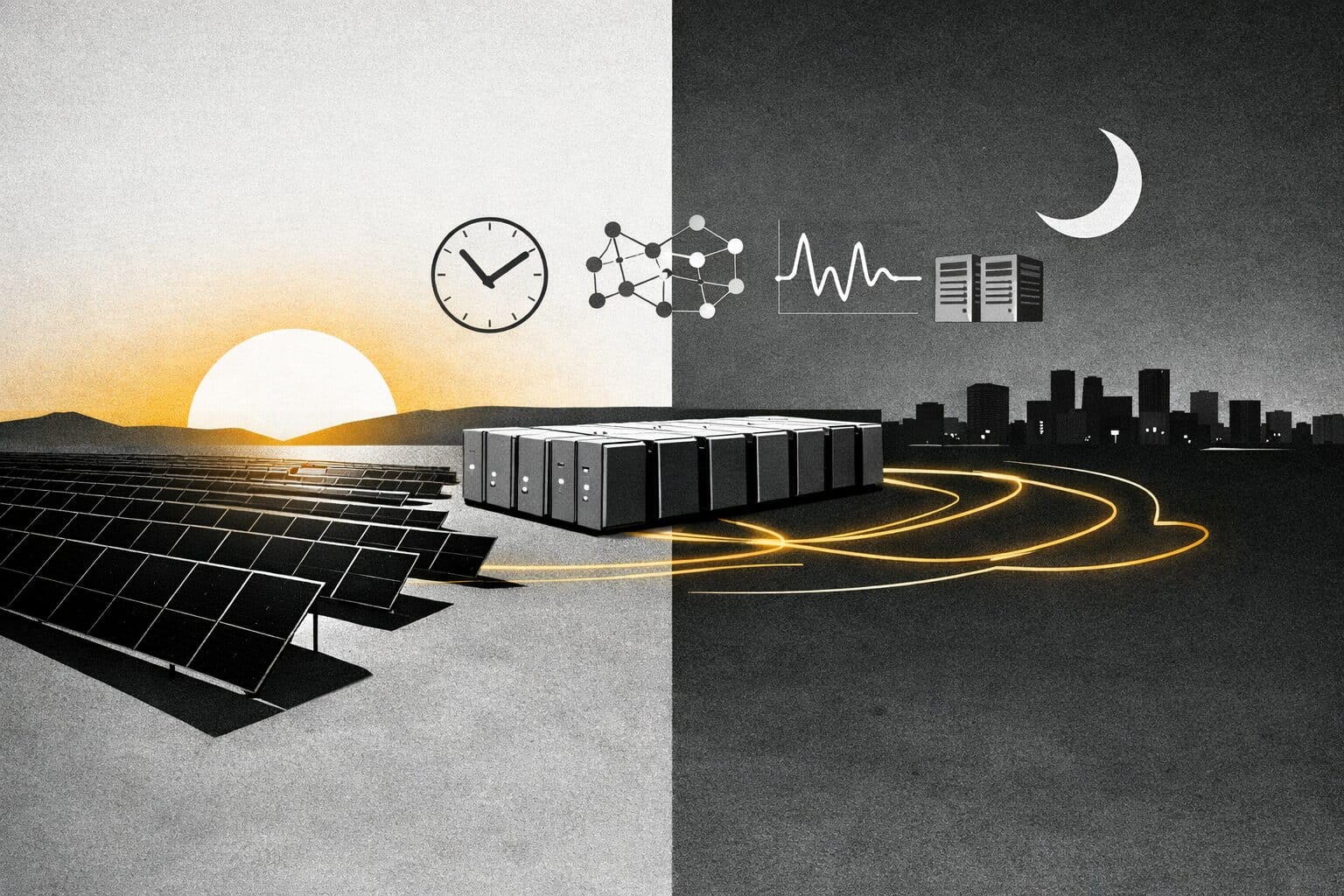
That also helps explain why storage is showing up more centrally in policy language. Official Chinese reporting in February said Beijing would promote the development of the “new energy storage industry” in 2026 as part of the push to accelerate a new power system. In other words, the next phase is not mainly about headline gigawatts. It is about control: transmission, balancing, storage, flexibility and system management. That is a much less romantic story than “more renewables,” but it is probably the more important one.
Coal is still in the room, and that is not accidental
This is the part many outside observers still resist. China’s energy-security doctrine is not post-fossil. It is hybrid. IEA data show coal made up 60.9% of China’s total energy supply in 2023. In electricity generation, the IEA says coal still provided almost 60% of China’s power in 2024, while renewables accounted for about 35%. Xi’s April remarks made clear that coal-fired power still occupies a foundational role as a reliability backbone and flexible support system even as the country accelerates wind, solar, hydropower and nuclear.
That may sound contradictory if the expectation is a neat moral transition from black to green. Beijing appears to see it differently. Variable renewables reduce long-run exposure to imported fuel and help electrify more of the economy, but they do not remove the need for controllable power in the world’s largest manufacturing base. China’s approach suggests that decarbonization will move fastest not by pretending intermittency is a solved problem, but by surrounding renewables with enough transmission, storage, market coordination, hydro, nuclear and thermal backup to keep the system stable under stress.
Geopolitics is turning climate tech into statecraft
The geopolitical backdrop makes that approach look less like hedging and more like doctrine. Reuters reported on April 8 that Asia relies on the Middle East for about 60% of its oil and 80% of its gas imports. Another Morgan Stanley analysis said Asia’s energy burden could rise to roughly 6.5% of GDP if Brent stays near $120 a barrel and gas prices remain elevated. For heavily importing economies, that is not an abstract energy-market problem. It is an inflation problem, a currency problem and a growth problem all at once.
China’s own fossil exposure remains substantial. Customs data reported by Reuters show crude imports averaged 11.55 million barrels a day in 2025, an annual record. Onshore crude inventories reached a record 1.206 billion barrels at the end of the year. Those are not the numbers of an economy that has transcended oil. They are the numbers of one that understands how dangerous oil dependence can be, and is buying time while it builds alternatives.
The same logic extends into transport. The IEA estimates that China accounted for almost two-thirds of global electric-car sales in 2024, with sales rising nearly 40% year on year. That is usually discussed as climate progress, and it is. But it is also a form of oil-risk management. Every additional EV, every incremental shift from combustion to electricity, trims the country’s long-term sensitivity to imported crude, refining costs and maritime disruption.
The uncomfortable lesson for the rest of the world
None of this means China has solved the climate problem. It remains the world’s largest coal consumer and top carbon emitter. Its power system is cleaner than before, but still deeply shaped by coal. Yet Beijing may be demonstrating something politically uncomfortable and strategically important: decarbonization becomes much harder to reverse when it is embedded not only in climate rhetoric, but in a broader doctrine of national resilience, industrial competitiveness and energy sovereignty.
That may be the bigger ClimateTech lesson of April 2026. The next phase of the transition is unlikely to be driven by idealism alone. It will be driven by countries trying to make themselves harder to squeeze. In that world, the decisive sectors are not only solar modules and wind turbines. They are transmission, storage, grid software, flexible demand, EV charging, nuclear supply chains and all the less glamorous system hardware that turns clean capacity into strategic endurance. China’s latest message is that the energy transition is no longer just about building a greener economy. It is about building one that can keep moving when the old energy order turns hostile.