When a company announces a 500-megawatt solar complex to support an oil major’s operations in West Texas, you expect the usual suspects: electrified field equipment, lower-carbon power for pumps and compressors, maybe a hedge against power price volatility.
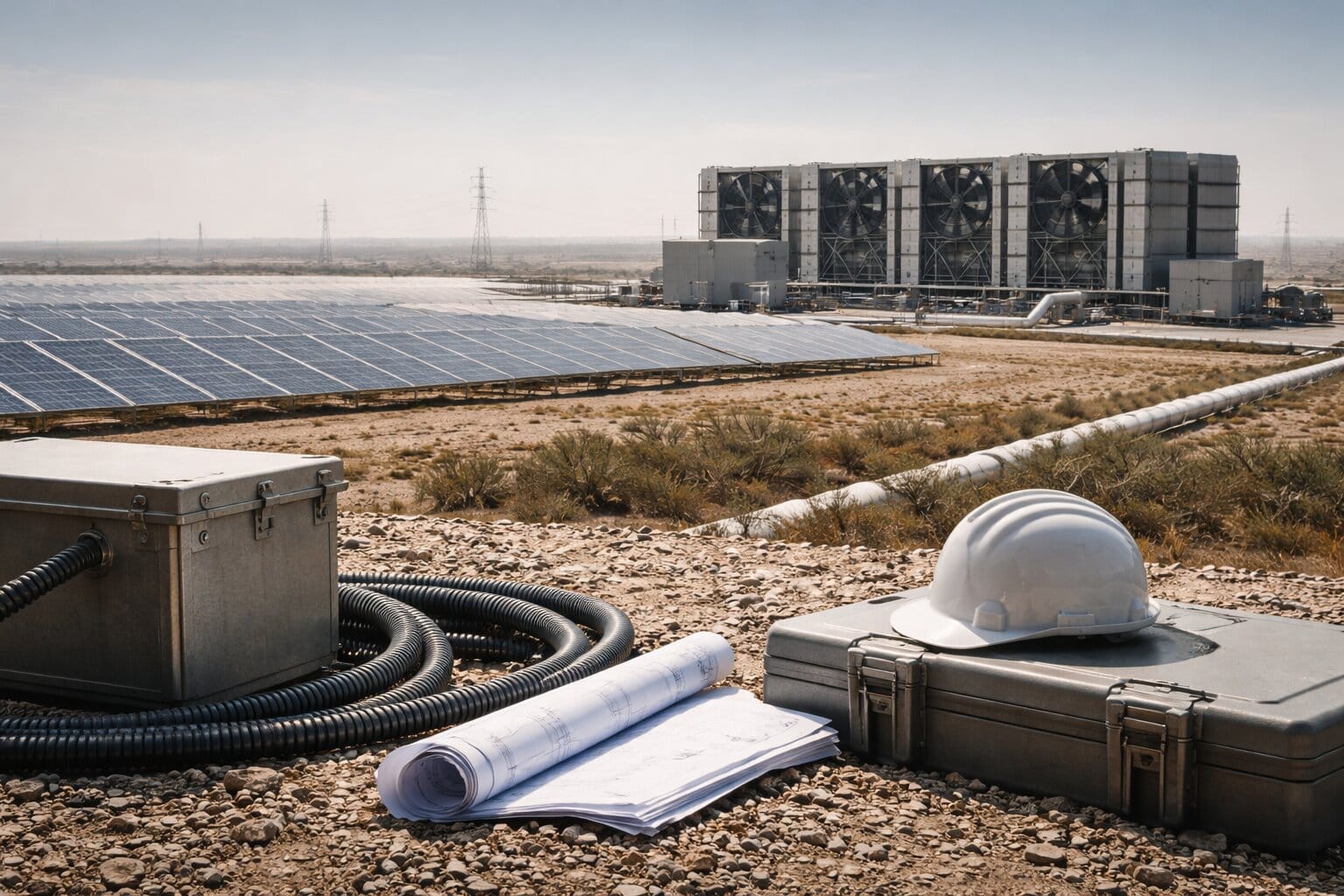
But Origis Energy’s February 19 announcement had a sharper edge: the Swift Air Solar facilities will also support Occidental’s West Texas operations including STRATOS — a direct air capture (DAC) plant intended to pull CO₂ out of ambient air. In other words, a “carbon vacuum” is getting its own purpose-built power supply.
That pairing—solar + DAC—sounds like a tidy climate narrative. In practice, it’s a preview of the real constraint on carbon removal: not chemistry, not fans, not even financing. Power.
Because if DAC is going to matter at climate scale, it won’t be limited by how fast we can build contactors. It’ll be limited by how fast we can build clean energy and storage—and the grid infrastructure to connect it—without cannibalizing the electricity we need for everything else.
A power plant for a carbon plant
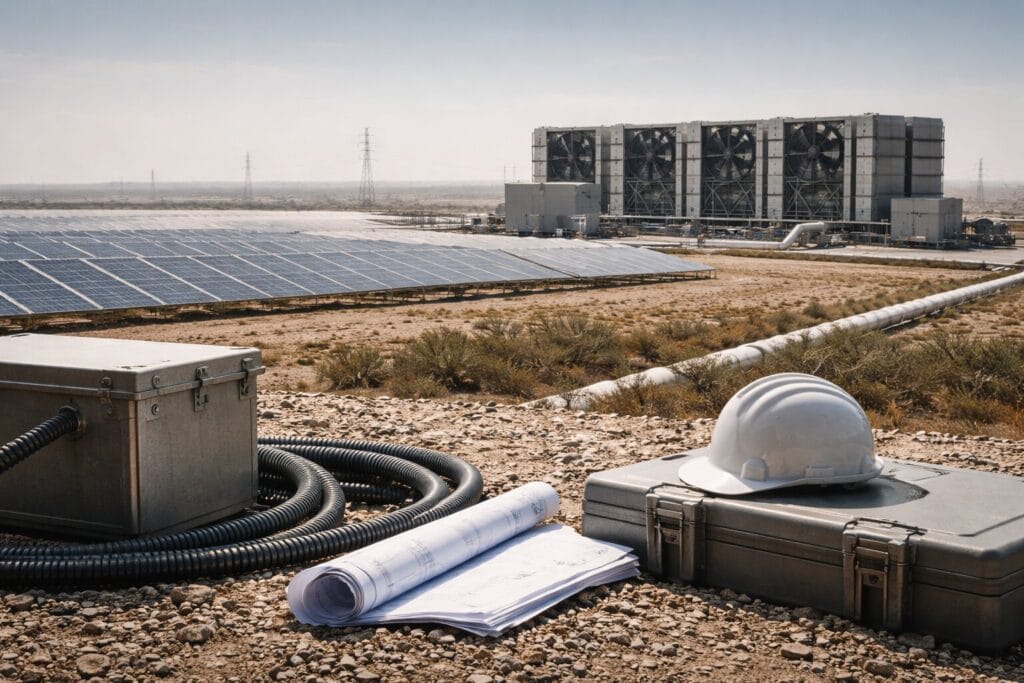
Origis says it has completed final commissioning and operation of three Swift Air Solar facilities totaling 500 MWdc built in three phases, with the last phase delivered in late 2025. The company put the total investment at more than $650 million in Ector County and the broader West Texas region.
On Origis’ own project page, Swift Air Solar is described as a 145 MWac operating project in Ector County, with Origis as builder, owner, and operator. The same page highlights how the deal is structured as “emissions-free power” supply for STRATOS and explicitly leans into additionality—the idea that DAC should not “take” clean power that would otherwise decarbonize the grid.
This is the first subtle lesson of the Swift Air story: DAC developers don’t just need clean power. They need new clean power.
Additionality is not a philosophical preference. It’s operational self-defense.
If a DAC plant runs on grid electricity in a region where marginal power still comes from fossil generation, the plant can end up removing CO₂ with one hand while pushing emissions into the system with the other. The carbon math gets ugly quickly.
So the business logic becomes: if you want high-integrity removal credits—measured, verified, and credible—you increasingly need to show dedicated clean energy and a storage pathway that looks like a real industrial supply chain, not a marketing claim.
The uncomfortable physics of pulling CO₂ from thin air
DAC has a branding problem and a physics problem. The branding problem is the oil-industry association. The physics problem is that CO₂ in air is extremely dilute—roughly a rounding error compared to the concentrations engineers are used to handling.
That dilution shows up as energy demand.
One widely cited process design for liquid-solvent DAC (the category STRATOS is associated with) estimated that, when CO₂ is delivered at high pressure suitable for transport/storage, the process requires either:
- 8.81 GJ of natural gas per tonne of CO₂, or
- 5.25 GJ of natural gas + 366 kWh of electricity per tonne of CO₂.
Those are not marginal numbers. They’re the core of the business model.
Now apply the arithmetic to STRATOS’ headline scale. STRATOS is designed to capture up to 500,000 tonnes of CO₂ per year once fully operational.
If you use the “gas + electricity” configuration above as a representative benchmark:
- Electricity: 366 kWh/t × 500,000 t/year ≈ 183 GWh/year
That averages to about 21 MW of continuous electric load (because 183 GWh spread over 8,760 hours ≈ 20.9 MW). - Heat (via natural gas): 5.25 GJ/t × 500,000 t/year ≈ 2.6 million GJ/year
That’s roughly 729 GWh/year of thermal energy—and that’s before you argue about efficiencies and integration details.
This is the second lesson of Swift Air: DAC is not “a plant.” It’s an energy conversion system whose output is negative emissions—if (and only if) the energy inputs are clean enough.
And the International Energy Agency (IEA) makes the implication explicit: liquid DAC relies on chemical processes that operate at high temperatures (hundreds of °C, up to ~900°C), and DAC in general is “currently energy intensive.” That’s not a critique. It’s a design constraint.
Solar helps, but it doesn’t close the loop by itself
Put the Swift Air numbers next to the DAC energy math and you see why a solar pairing is attractive—but also why it’s not automatically a climate slam dunk.
A 145 MWac solar project is, on paper, far larger than the ~21 MW average electricity draw implied by the benchmark energy intensity above. Even allowing for solar intermittency, curtailment, and seasonal variation, you can see the strategy: cover the electric side of DAC with clean power and avoid the reputational sinkhole of “carbon removal powered by marginal fossil electrons.”
But here’s the catch: for liquid-solvent DAC, the hard part is often heat, not electricity. High-temperature processing is not trivially solved by buying more solar unless the system is designed for deep electrification (high-temperature electric heat) and paired with substantial storage—or it taps other clean heat sources.
So Swift Air is best understood as a foundation, not a full solution: it supports the DAC plant’s power needs and helps strengthen the “additionality” story, while the broader system still has to prove:
- how continuous operations are handled (DAC prefers steady operation; solar is variable), and
- how high-temperature thermal demand is supplied without compromising net-negative claims.
This is why the next generation of “DAC + clean power” projects will likely be bundled with one or more of the following:
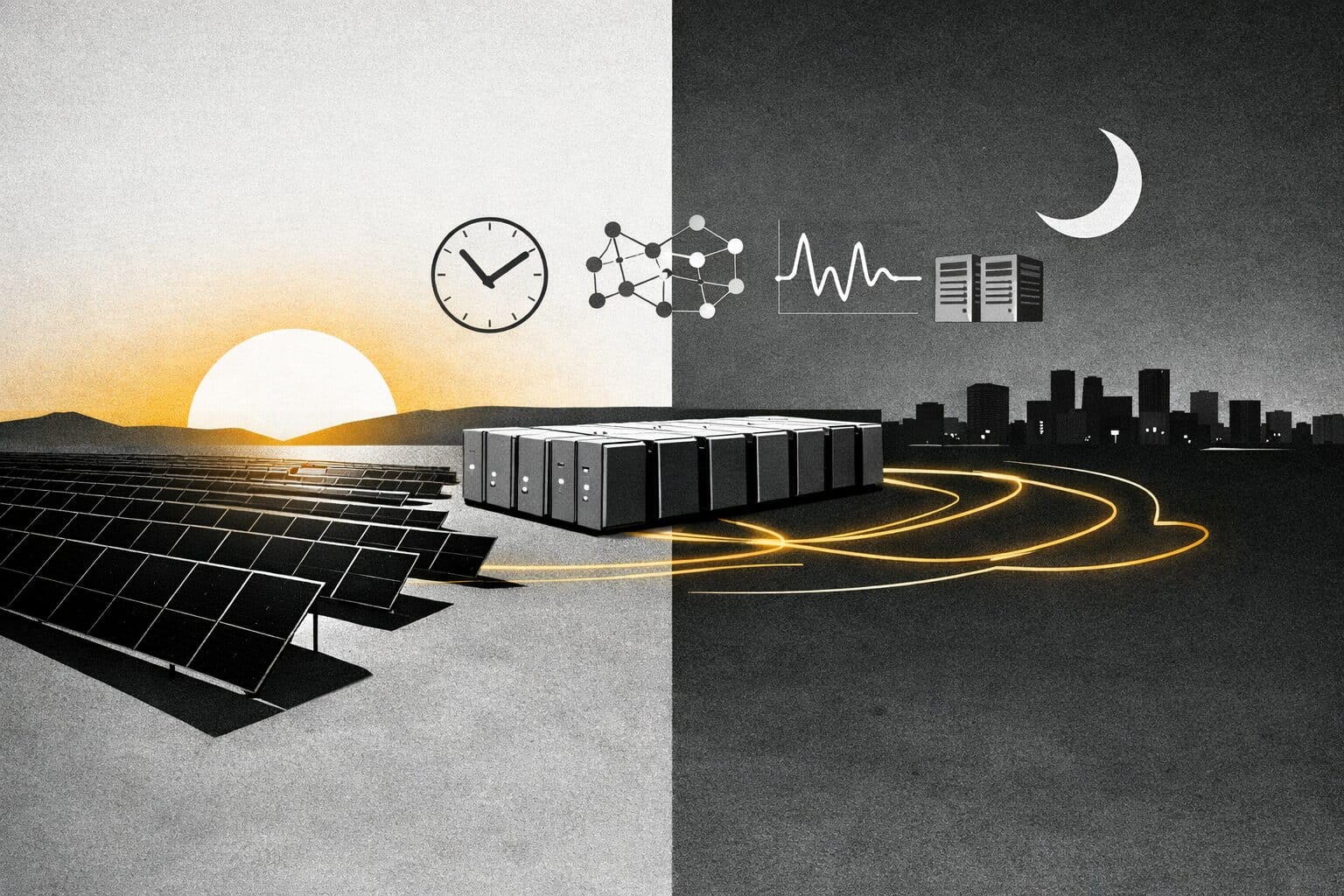
- Grid interconnection + storage (to firm renewable electricity)
- On-site storage sized not for a few hours, but for operational continuity
- Clean heat strategies (waste heat, geothermal, electrified heat, or decarbonized fuels)
- Flexible DAC operation designed to ramp with renewable availability (a non-trivial engineering and economics problem)
In other words: the real product isn’t a plant. It’s a dependable carbon-removal supply chain.
Policy turns the math into a market
DAC would still be largely a science-project category without one policy lever: the U.S. 45Q tax credit, which the IEA notes was expanded under the Inflation Reduction Act to up to $180 per tonne for DAC CO₂ that is permanently stored.
That number is doing heavy lifting. If removal costs are in the high hundreds of dollars per tonne today (as many market transactions imply), $180/tonne doesn’t make DAC cheap—but it can make it financeable when combined with:
- corporate offtake agreements for removal credits,
- transferability/monetization mechanisms,
- and a credible storage pathway that avoids accusations of “temporary” removal.
The IEA also notes that operating CO₂ storage sites can take ~3 to 10 years to develop from conception to injection. That matters because it reframes what “DAC scaling” actually means: you’re not scaling a device, you’re scaling a regulated subsurface industry.
Occidental has emphasized that STRATOS is intended to store CO₂ in deep geologic formations and has pursued (and publicized) permitting progress for Class VI injection wells. That permitting and MRV infrastructure may end up being as important as capture technology in determining whether DAC becomes an investable, repeatable asset class.
Swift Air fits neatly into this policy-plus-infrastructure story. If regulators, buyers, and carbon market watchers demand additionality, then purpose-built power isn’t a cost—it’s part of credit integrity.
The scale reality check (and why it still matters)
Here’s the part DAC proponents and critics often talk past each other on.
STRATOS at full capacity (500,000 tonnes/year) would be a genuine industrial milestone—one of the largest DAC plants on the planet by design capacity, and far larger than today’s operating DAC sites. It could also become a template for “bankable DAC” if it demonstrates reliable operations, durable storage, and trustworthy measurement.
But in climate terms, it is still tiny.
The IEA estimates energy-related CO₂ emissions hit ~37.8 gigatonnes in 2024. A 0.5-million-tonne DAC plant offsets about 0.0013% of that annual total.
That sounds damning—until you consider what the IEA also says about the DAC pipeline: there are dozens of commissioned plants (mostly small), a much larger number planned, and DAC might reach ~3 Mt/year by 2030 if projects in advanced development proceed—still a small fraction of what net-zero scenarios call for.
So the right lens isn’t “does STRATOS solve climate change?” It doesn’t.
The right lens is: does STRATOS prove a repeatable infrastructure pattern—permitting, power supply, storage, MRV, financing—that can be copied hundreds or thousands of times if policy and markets insist on engineered removals?
That’s what Swift Air is really underwriting: not just a plant, but a pattern.
The oilfield paradox is the point, not a side note
There’s no avoiding the tension here. DAC is increasingly being built by, financed by, or partnered with companies whose core business is fossil extraction. Critics argue this can become a license to delay emissions cuts or route captured CO₂ into oil-boosting applications.
Developers counter that engineered removals are necessary for hard-to-abate emissions and that DAC offers durable, measurable removal—especially when CO₂ is permanently stored.
Swift Air doesn’t resolve that debate, but it does sharpen it:
- If you build a DAC plant and power it with fossil-heavy grid electricity, credibility collapses.
- If you build purpose-built solar and commit to durable storage, you move the conversation from “is this greenwashing?” to “is this the best use of scarce clean energy?”
That second question is harder—and more interesting.
Because the uncomfortable truth is that the clean power required for carbon removal competes with the clean power required for everything else: electrifying transport, decarbonizing industry, meeting AI-driven load growth, and keeping grids stable in a hotter world.
Which means DAC’s future may hinge on one capability above all:
Can carbon removal scale without slowing the energy transition?
(Swift Air is one attempt to answer “yes.”)
What to watch next
If you’re tracking this as ClimateTech—not just energy news—here are the signals that will matter more than ribbon cuttings:
- Operations and ramp: When STRATOS begins capturing at scale, how quickly does it ramp, and how steady is output?
- Energy mix transparency: How much of the plant’s electricity is actually backed by Swift Air on an hourly basis, and what fills the gaps?
- Heat decarbonization: Is high-temperature heat supplied in a way that preserves true net-negative performance?
- MRV credibility: How are storage integrity and leakage risk addressed, and how transparent are monitoring results?
- Cost curve evidence: Do delivered removal credits meaningfully decline in cost with operational learnings—or stay stuck in premium territory?
- Replication: Do we see more “DAC + dedicated clean power + storage” packages emerge as a standard project finance template?
Swift Air and STRATOS won’t decide the carbon-removal debate on their own. But they may decide something more practical: whether DAC becomes a niche offset product—or a scalable, infrastructure-grade tool that can coexist with, rather than compete against, the broader clean-energy buildout.