A new partnership between Energy Vault and Peak Energy bets that sodium-ion storage can do two things at once: cut fire risk and cut time-to-power for AI facilities. The harder question is whether chemistry alone can outrun grid bottlenecks, cheap lithium-iron phosphate, and tax-credit fine print.
On February 9, Energy Vault said it had signed a strategic development agreement with Peak Energy — and locked in an initial 1.5 gigawatt-hours (GWh) supply of U.S.-manufactured sodium-ion battery systems. The pitch is unusually direct: build a storage architecture “purpose-built” for AI data centres, integrate it into Energy Vault’s control software (Vault OS), and use domestic sourcing to improve project economics via the Domestic Content bonus for U.S. clean-energy tax credits.
At first glance, this looks like another battery deal in a market full of them. But it lands at a moment when data centres are changing the power system faster than regulators, utilities and equipment makers can keep up.
The International Energy Agency (IEA) projects electricity generation needed to supply data centres could rise from 460 terawatt-hours (TWh) in 2024 to over 1,000 TWh by 2030 and 1,300 TWh by 2035 in its base case. The problem is not only scale. Data centres cluster in specific places — turning what looks manageable in a national forecast into a local grid emergency.
This is where “AI-first” storage enters the conversation. Not because batteries can magically create electrons, but because they can change when and how electricity is used — and, increasingly, how quickly a data centre can be connected and operated.

The real constraint is time-to-power, not just megawatts
The U.S. Energy Information Administration expects U.S. electricity consumption to keep breaking records, rising from 4,195 billion kWh in 2025 to 4,268 billion kWh in 2026 and 4,372 billion kWh in 2027, driven in part by AI and crypto data centres.
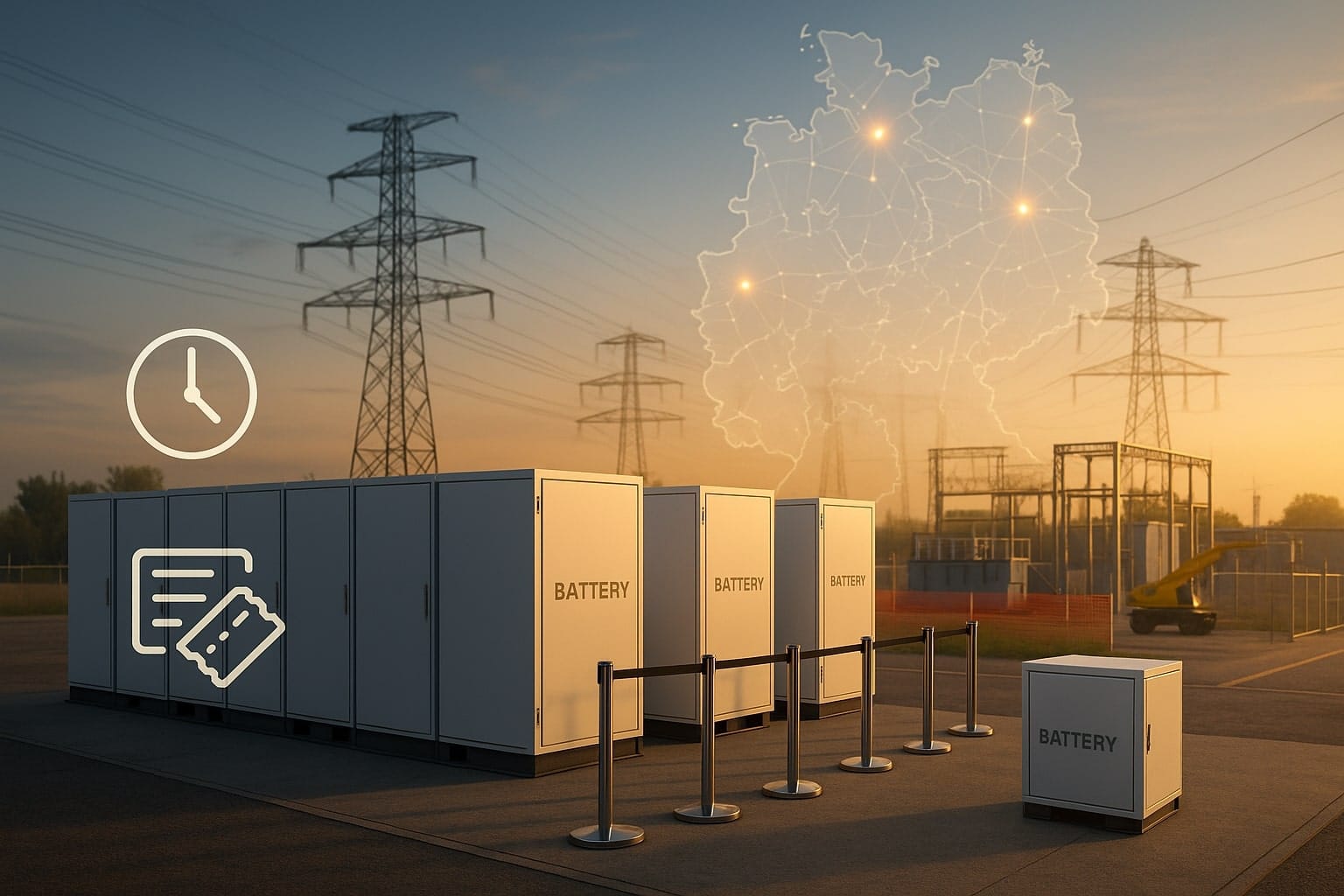
Developers feel this pressure in a simple way: grid interconnection queues are long, transmission upgrades are slow, and equipment lead times can be brutal. In that environment, the fastest project is often not the one with the cleanest power contract — it is the one that can operate while waiting for the grid to catch up.
Batteries help in at least three practical ways:
- Smoothing “spiky” loads. AI training and inference can create high peak demand and rapid swings. Energy Vault and Peak argue conventional battery systems are designed for steadier grid profiles and are not optimised for these volatile patterns.
- Reducing the dependence on legacy backup architecture. The companies say their integrated design can mean simpler electrical layouts, less reliance on traditional uninterruptible power supply (UPS) systems, and lower cooling needs.
- Creating a “power buffer” for constrained grids. A behind-the-meter battery can absorb cheap power off-peak and discharge during local peaks, easing demand charges and (in some markets) supporting grid services.
The headline number — 1.5 GWh — is meaningful in data-centre terms. It is 1,500 megawatt-hours (MWh). Depending on design assumptions, that is enough energy to supply 100 MW for 15 hours, or 300 MW for 5 hours (purely as arithmetic, before accounting for redundancy, conversion losses, and the specific duty cycle).
In other words: this is not a pilot-scale order. It is a real attempt to productise storage as part of the data-centre “shell”, not as a bolt-on container in the parking lot.
Why sodium-ion now, when lithium batteries are getting cheaper?
There is a twist: stationary batteries have become cheap enough to trigger new use cases. BloombergNEF estimates the average pack price for stationary storage systems dropped to $70/kWh in 2025, 45% lower than in 2024, driven largely by fierce competition and overcapacity in China. BloombergNEF explicitly expects more on-site storage deployments at commercial and industrial facilities — including data centres — as prices fall.
That sounds like bad news for any alternative chemistry. If lithium-iron phosphate (LFP) is flooding the market at low prices, why switch?
Because cost is not the only variable that data-centre operators care about. Two others are starting to dominate boardroom conversations:
1) Safety and insurability
Sodium-ion advocates argue their chemistry can be safer under abuse conditions — with lower fire risk and less violent failure modes in some configurations. A 2025 peer-reviewed review of thermal runaway risks notes that while both lithium-ion and sodium-ion batteries can experience thermal runaway, certain sodium-ion electrolytes may react less violently under thermal stress, and the absence of flames in some sodium-ion chemistries could indicate a potential safety advantage — while also stressing that large-scale safety assessments for sodium-ion remain limited compared with lithium-ion.
For AI facilities, this matters. Insurers and local fire authorities are becoming more involved in battery siting. Operators want fewer surprises — and “bankable” safety is not just engineering, it is permitting time and insurance premiums.
2) Supply chain politics and project finance
Energy Vault and Peak are leaning hard on domestic manufacturing. Their announcement says the 1.5 GWh supply is U.S.-manufactured, and suggests projects could qualify for Domestic Content Investment Tax Credit (ITC) benefits.
Here the tax detail is not small print — it can shift returns. The IRS explains that the domestic content bonus can increase the ITC “energy percentage” by 10 percentage points for projects that meet domestic content requirements and satisfy prevailing wage and apprenticeship rules (otherwise the increase can be 2 percentage points).
So if a storage project already qualifies for the higher ITC level through labour compliance, domestic content can add another meaningful slice of value. In a market where financing is sensitive to a few percentage points of after-tax yield, that is not trivial.
The supply chain argument is also broader than tax credits. Wood Mackenzie notes China manufactures about 80% of the world’s lithium-ion batteries, produces about 64% of global refined lithium, and nearly 90% of cathode materials. A U.S.-made sodium-ion product offers a narrative that many developers and policymakers want: diversify away from one dominant supply chain.
The irony is that China also leads sodium-ion manufacturing today — which means “sodium” does not automatically mean “non-Chinese”. But the raw material itself is globally widespread, and Wood Mackenzie points out sodium is the sixth-most common element in the earth’s crust, about 1,000 times more abundant than lithium. The implication is that building new supply chains may be easier — if the industrial base shows up.
The uncomfortable truth: sodium-ion is not yet the cheapest
Even supporters should be careful not to over-claim. Wood Mackenzie estimates that in 2025 sodium-ion batteries still cost more, on average, than LFP for equivalent storage capacity — $59/kWh for sodium-ion vs $52/kWh for LFP — and does not expect cost parity until around 2035 (while noting that some companies claim operational advantages can make sodium-ion competitive sooner).
Meanwhile, lithium’s cost curve keeps moving. BloombergNEF’s pricing suggests stationary storage economics are improving quickly, especially where Chinese supply is available. That sets a high bar for any alternative chemistry trying to win on price alone.
So sodium-ion’s near-term case is likely to be niche and specific:
- sites with strict safety requirements,
- projects where domestic content materially boosts economics,
- places where temperature performance or operational characteristics matter,
- operators willing to pay for a more integrated power architecture.
“Powered shells” and a deeper shift in data-centre thinking
Energy Vault calls the integrated solution a differentiator for its modular “powered shell” data centre offering, claiming it simplifies electrical design and reduces reliance on traditional UPS systems. That language matters, because it hints at a bigger strategic shift: the data centre as a power product, not merely a building that consumes power.
This would align with what the market is already signalling. Google, for example, has signed long-term solar agreements in Texas totalling 1 GW of capacity (equivalent to 28 TWh over 15 years), explicitly framing new generation as a way to improve local reliability and affordability.
In that world, batteries are no longer just backup. They become part of how data-centre developers negotiate with utilities, optimise power costs, and keep expansion schedules on track.
Energy Vault itself has been moving in this direction. Data Center Dynamics notes it previously partnered with RackScale Data Centers in December 2024 on a plan to deliver 2 GW / 20 GWh of primary power to data centres through battery energy storage systems. The Peak partnership looks like an attempt to standardise the “battery + software + data-centre design” stack around a new chemistry.
What to watch next
For all the excitement, three questions will decide whether sodium-ion becomes a serious data-centre technology, or another promising chemistry that stays on the sidelines.
1) Can sodium-ion be financed like LFP?
Banks and tax equity providers will want long warranties, predictable degradation, and credible safety data at scale. The literature on safety is promising but still calls out the need for more large-scale real-world testing.
2) Does “domestic content” survive contact with procurement reality?
The domestic content bonus is real, but qualification depends on how components are sourced and documented. The value is highest when projects already meet labour rules that unlock the higher credit.
3) Does the battery solve a real operational pain?
Energy Vault and Peak emphasise volatile AI loads, simplified electrical design, reduced UPS dependence, and lower cooling requirements. If operators can prove measurable gains — faster commissioning, fewer outages, better efficiency under fluctuating workloads — the chemistry debate becomes secondary.
The bigger point: the grid is becoming a software problem, too
The IEA warns that data centres, unlike many other new electric loads, concentrate geographically — making their grid integration harder even if national totals look manageable. That is why storage and demand flexibility are becoming part of the “permit to grow” for AI infrastructure.
Sodium-ion will not fix grid queues. It will not replace transmission. And it will not make electricity free.
But it may fit a specific gap in the market: a battery that is good enough on cost, better on safety, and better aligned with U.S. industrial policy — wrapped in a software layer that speaks the language of uptime.
If that is the direction data centres are heading, then the most important story here is not “salt beats lithium”. It is that the AI boom is forcing a redesign of the power stack — from the chemistry inside the cell to the way a facility connects to the grid.