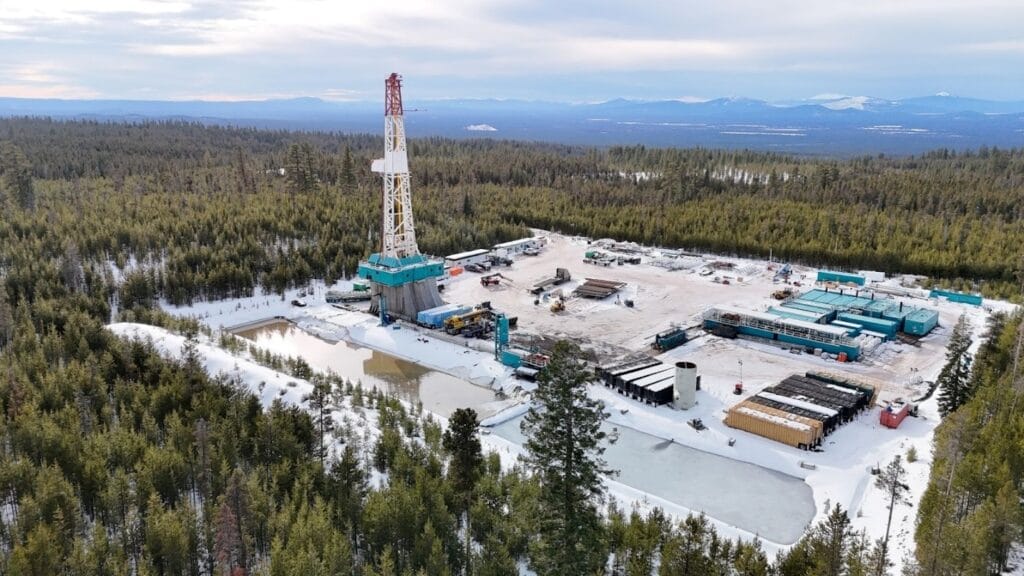
A Khosla-backed startup has drilled into some of the hottest rock ever accessed by an enhanced geothermal project—331°C at Oregon’s Newberry Volcano. The promise is compact, 24/7 clean power sited where data centers need it. The catch is the engineering.
The record grabbed headlines: Mazama Energy says it has created the hottest enhanced-geothermal system (EGS) to date, logging 629°F (331°C) at the bottom of a new production well at Newberry Volcano in central Oregon. Backed by Khosla Ventures and Gates Frontier, the company also reports confirmed hydraulic connectivity between an injector and a 10,200-foot deviated producer, plus a plan to follow with a 15-MW pilot in 2026 and a 200-MW build-out at the same site. The pitch is explicit: this is round-the-clock clean power designed for AI-era data centers.
If true at scale, it matters. Hyperscale computing has turned electricity into the new capex. The IEA now expects global data-center consumption to roughly double to ~945 TWh by 2030, growing ~15% per year—over 4× faster than total electricity demand. And in the United States, recent syntheses suggest data centers are already ~4% of load and could account for roughly half of demand growth this decade. Clean, firm megawatts that fit inside tight land and transmission constraints are the constraint.
Below is what actually happened, what “superhot” really buys you, and the questions that still decide whether this becomes a fleet—not just a first.
What just happened at Newberry
Mazama re-entered a legacy well as an injector, drilled a new deviated producer to ~10,200 feet, and reports “comprehensive connectivity” between the two. Bottom-hole temperatures hit 331°C, which the company calls the “world’s hottest EGS.” It also published unusually specific drilling performance KPIs (peak 100 ft/hr penetration, 2,760-ft bit runs through volcanic formations; zero motor/electronics failures) and flagged a proprietary “Thermal Lattice” stimulation approach informed by oil-and-gas practices. LCOE targets are “<5¢/kWh”—ambitious, but squarely stated as targets.
Independent coverage has so far hewed to the facts: that an enhanced system (not a naturally permeable hydrothermal field) reached these temperatures; that the site sits on Newberry Volcano in Oregon; and that the investor narrative is all about AI’s 24/7 power need.
Why temperature matters (and what “superhot” actually means)
At ~331°C Mazama is still below the 374°C / 22.1 MPa critical point of water—the threshold at which water becomes a supercritical fluid with very different transport properties and much higher energy density per kilogram. “Superhot rock” programs typically define their target window as ~400–450°C at depth. Crossing that line is what unlocks the dramatic power-per-well gains touted by advocates.
Context helps: Iceland’s IDDP-2 research well in 2017 reached ~426–427°C at ~4.5–4.7 km, achieving supercritical conditions—but it was not an EGS; it tapped a unique, naturally permeable deep hydrothermal system. Mazama’s claim is narrower: hottest for an enhanced system created by stimulation and connectivity between wells. Those are different technical leagues.
The prize if Mazama (and others) push into the >400°C “superhot” regime is simple to state: more watts per well (company claims ~10× power density), fewer wells (~80% fewer, by their estimate), and lower water use (~75% less). Those figures are company claims, but they track the physics—enthalpy rises sharply with temperature.
The data-center lens: siting, 24/7 accounting and the interconnection choke point
Two system realities explain why this breakthrough drew so much AI attention:
- Hourly, 24/7 clean power accounting is arriving. Hyperscalers are moving beyond annual “REC balancing” toward hourly matched clean power using EnergyTag-style granular certificates. Firm resources located near load are the cleanest way to hit those hourly scores without overbuilding storage.
- Interconnection queues are the bottleneck. The U.S. has had ~2.6 TW of generation and storage projects in transmission queues—more than double today’s installed capacity. Timelines often stretch years. A power source that can be built behind the meter or on constrained nodes is far more valuable than its raw LCOE would suggest.
On economics, independent modelling from Rhodium Group found that behind-the-meter EGS could meet up to ~64% of forecast U.S. hyperscale demand growth by early 2030s, if developers can site close to data-center clusters at competitive costs. That’s the aperture Mazama wants to walk through.
What’s genuinely new—and what is still hard
New:
- Temperature + EGS: Reaching 331°C in an engineered reservoir is new. Previous EGS milestones (e.g., Utah FORGE) demonstrated connectivity and stable heat extraction around ~188–188°C (370°F) with >90% fluid recovery, but not in the superhot regime. Mazama is the first to put EGS into the low-to-mid-300s°C.
- Execution signal: Publishing penetration rates, bit-run lengths and tool survival at high temperatures is a quiet confidence tell. Those are the variables that usually kill the budget.
Still hard:
- Materials & well integrity at >400°C. The most common failure mode in superhot concepts remains well construction—cement, casing connections, packers, elastomers and electronics under huge thermal cycling. This is solvable, but it’s the difference between a demo and a 30-year asset.
- Reservoir sustainability. At very high temperatures, fracture networks evolve, and fluids can become corrosive. Keeping permeability while avoiding short-circuiting or scaling is the reservoir-engineering game. (DOE’s superhot program has been explicit about this.)
- Seismic stewardship. Newberry isn’t a blank slate. Earlier EGS work here (a decade ago) was closely monitored for induced microseismicity. The industry now has playbooks for doing this safely—but social licence will depend on continuous, transparent monitoring.
How to read the cost claims
Mazama’s “<5¢/kWh” target is aggressive. For reference, NREL’s ATB still treats near-term EGS costs as modelled rather than empirically anchored, precisely because no commercial-scale dedicated EGS plants operate in the U.S. yet. Updated drilling-cost curves are improving (FORGE/Fervo data show faster rates and cheaper wells), but the learning curve is just beginning. Treat the cost claim as a forward-looking target tied to drilling speed, well count, and reservoir performance—not a bid price.
That said, system value in data-center geographies may outrun cost: firm, on-site clean power that shaves interconnection risk and scores hourly CFE can be worth more than a merchant-market MWh. That is the bet. (And it’s why hourly accounting matters so much.)
Where it could work—and how fast
Two mapping efforts are worth watching:
- Project InnerSpace GeoMap (now with a data-center siting module) is being used by developers to overlay heat depth, grid and load. It’s a living map of “where wells pencil.”
- CATF/University of Twente superhot depth maps provide a global view of where ~450°C is accessible at practicable depths—a coarse but useful screen for superhot prospects.
Mazama itself says Newberry’s superhot interval sits <5 km down—shallow by global standards and one reason the 200-MW concept is even discussable. If drilling and completions scale as advertised, Newberry could become the template site for “AI-adjacent” geothermal.
The risk ledger (and what would change our mind)
What could go right (near-term):
- Hotter step-out in 2026 that cracks >400°C and proves stable flow and well integrity over multi-month tests.
- A bankable O&M playbook for tools, cements and casing at superhot temperatures.
- A behind-the-meter pilot with a hyperscaler that demonstrates hourly matched, 24/7 carbon-free power on a real load.
What could still break it:
- Thermal-mechanical fatigue that shortens well life and trashes economics.
- Permeability decay or chemistry (scaling/corrosion) that drags capacity down.
- Permitting or social-licence missteps if seismic protocols aren’t bullet-proof. (Newberry’s history means scrutiny.)
Bottom line
This is novel, consequential progress: EGS at 331°C with demonstrated well-to-well connectivity. It pushes an engineered geothermal reservoir into temperatures where power density bends the math for compact, 24/7 clean power near load—exactly what the AI build-out lacks. But the superhot threshold is still ahead; the materials science and reservoir stability questions will decide whether this becomes a 200-MW asset class or remains an impressive demo. In the meantime, the strategic logic is solid: if you can convert the AI power problem into a geology and drilling problem—and win—that’s a moat.